Qualcomm, a company that designs and manufactures chips for mobile phones and other electronics, is acquiring Arduino, an Italian company known for its open-source hardware and software ecosystem. In its announcement , Qualcomm emphasized that Arduino will “retain its brand and mission,” its open-source philosophy, and its “support for chips from multiple manufacturers.”
“As we enter this new chapter within the Qualcomm family, Arduino will retain its independent brand, tools, and mission while continuing to support a broad range of microcontrollers and microprocessors from a variety of semiconductor manufacturers,” Qualcomm said in a press release. “With this acquisition, the more than 33 million active users of the Arduino community will gain access to Qualcomm Technologies’ powerful technology stack and global reach. With the support of Qualcomm Technologies’ advanced technologies and extensive partner ecosystem, entrepreneurs, businesses, tech professionals, students, educators, and enthusiasts will be able to quickly prototype and test new solutions with a seamless transition from prototype to commercial product.”
The deal’s value was not disclosed, and it was noted that it still must be approved by regulators and subject to “other customary conditions.”
Although Qualcomm repeatedly emphasizes that Arduino will continue to exist as a standalone ecosystem, users are already voicing concerns. After all, when a large company acquires an open-source project, it often ends up restricting the ecosystem. The community fears this could lead to reduced support for third-party chips and could also mean a refocusing of Arduino’s efforts on Qualcomm’s larger enterprise clients.
The first fruit of the upcoming deal will be the Arduino UNO Q device , a single-board computer that is positioned as the most powerful Arduino board ever created, equipped with an STM32U585 microcontroller (MCU) and a Qualcomm Dragonwing QRB2210 chip .
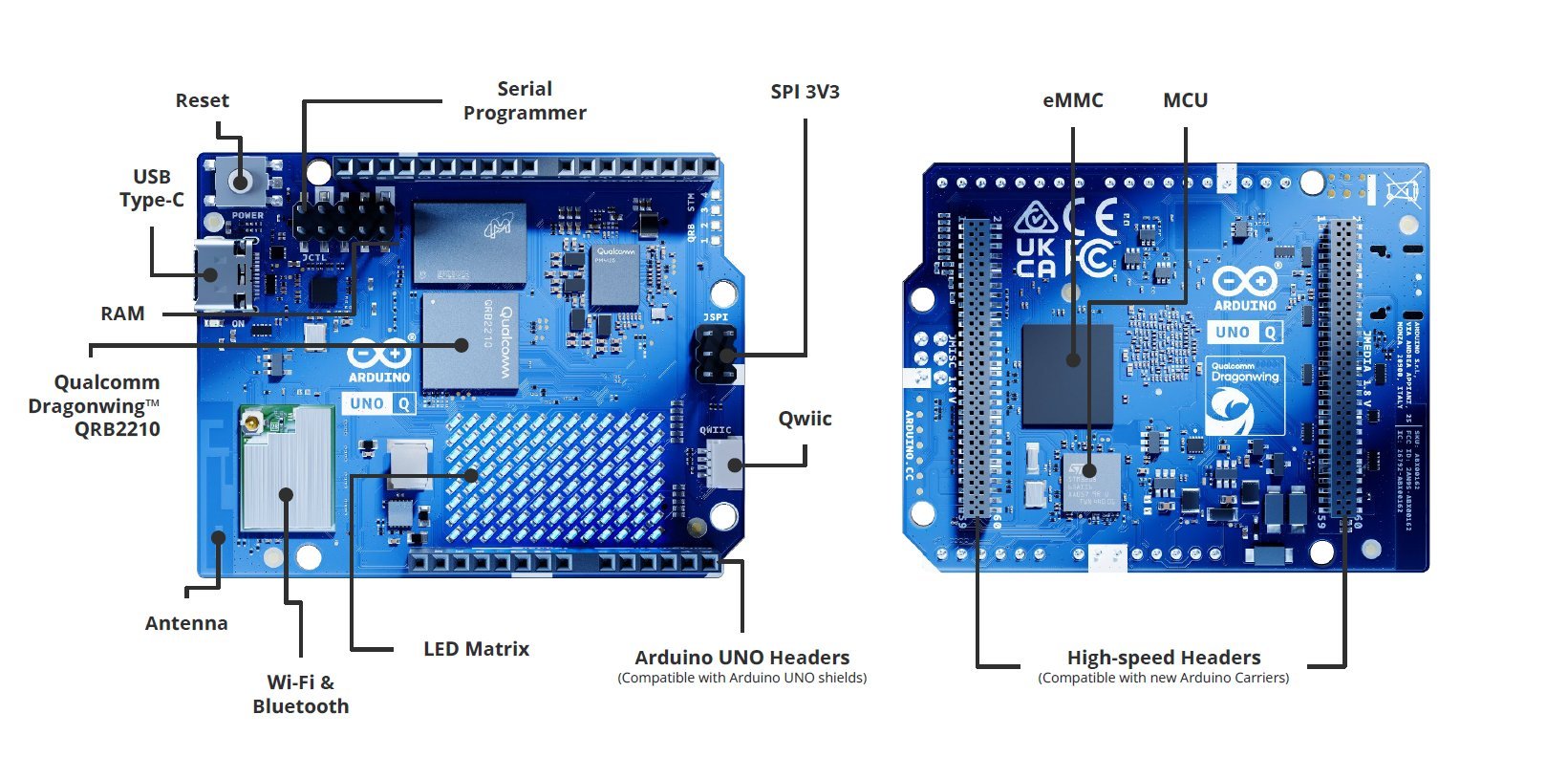
The developers write that the single-board computer will have a “dual brain”: a CPU capable of running “standard Debian Linux” (a dig at Raspberry Pi OS, which is a fork of Debian), as well as a microcontroller for real-time tasks, which should combine “high-performance computing with real-time control.”
The QRB2210 features a quad-core Arm Cortex-A53 processor and a Qualcomm Adreno 702 GPU, and also supports Bluetooth 5.1, Wi-Fi, eMMC memory, and classic Arduino headers for compatibility with UNO shields, all combined with a real-time microcontroller.
The back of the board features new connectors designed to handle the capabilities of the Dragonwing SoC.
The UNO Q can be used as a standalone device by connecting a keyboard, mouse, and monitor (like a Raspberry Pi). It can also be used in conjunction with a PC running a development environment.
The UNO Q will initially come in two versions: a 2GB RAM and 16GB eMMC storage version priced at $44, and a 4GB RAM and 32GB eMMC storage version that will go on sale next month for $59.
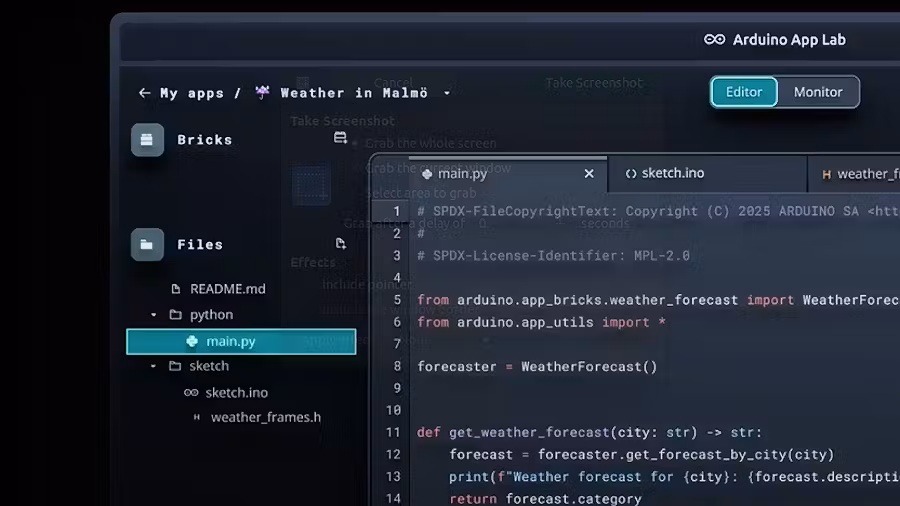
Additionally, a new development environment, Arduino App Lab, was introduced alongside UNO Q. It aims to unify the real-time workflow with code, Linux applications, and—thanks to Qualcomm’s involvement—AI.
App Lab is integrated with the Edge Impulse AI platform, acquired by Qualcomm earlier this year. This is expected to simplify the creation and optimization of AI models. Additionally, users will be able to import pre-trained models from the Qualcomm AI Hub platform .
“Joining forces with Qualcomm Technologies will allow us to accelerate our mission to make technology accessible and innovative,” commented Arduino CEO Fabio Violante. “The launch of UNO Q is just the beginning. We want to empower the global community with powerful tools that will make AI development intuitive, scalable, and open to everyone.”